
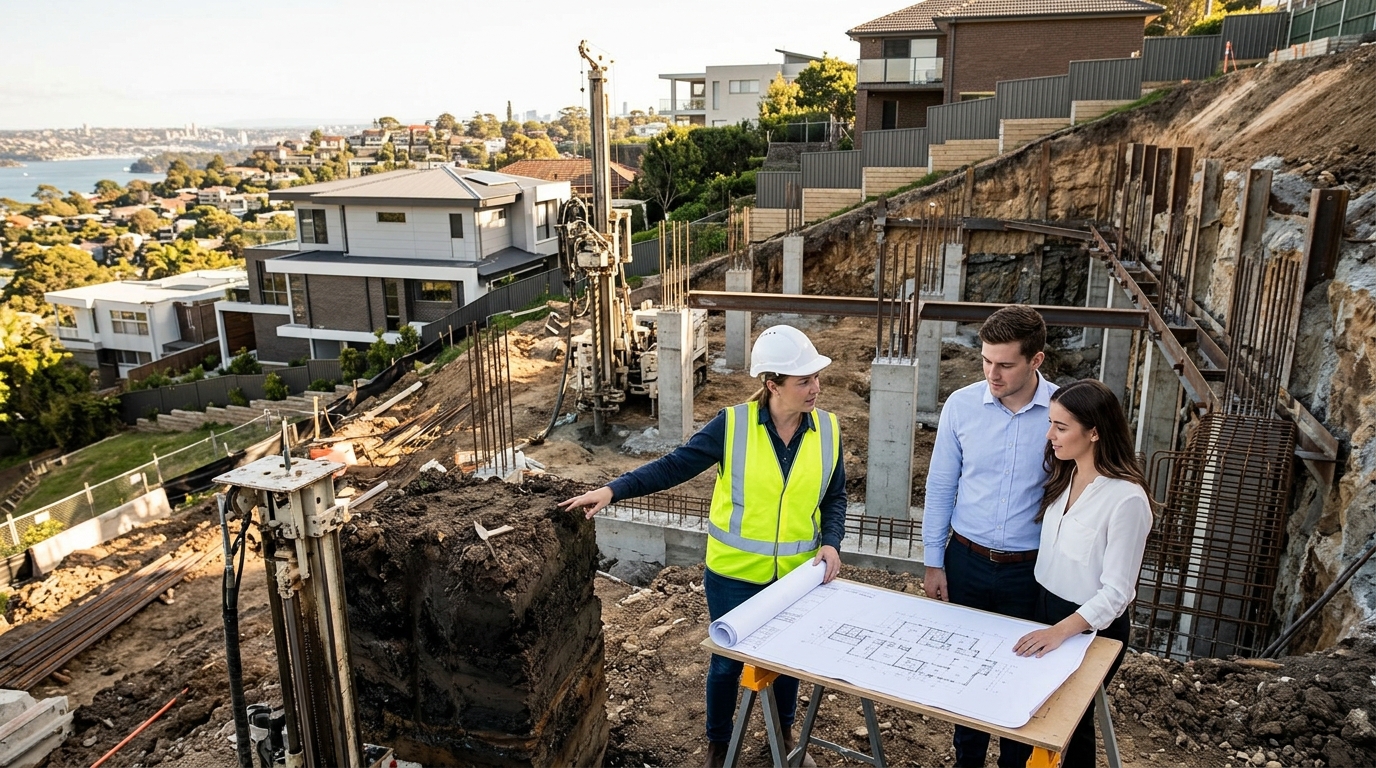
Soil type directly impacts building costs on steep Sydney properties by dictating foundation depth, engineering complexity, and site preparation requirements. Unstable or expansive soils require specialized engineering solutions that significantly increase project budgets. Understanding these geotechnical factors early helps homeowners plan realistic financial expectations for their new builds.
Understanding Soil Classification in Construction
Soil-structure interaction analysis evaluates the collective response of three linked systems: the structure, the foundation, and the soil underlying and surrounding the foundation, according to the National Institute of Standards and Technology. This scientific approach is critical for steep sites where gravity and water pressure create unique stress points. Engineers measure soil strength to determine how easily the ground changes shape or shifts under load.
Soil texture and clay content are primary determinants of construction difficulty. Building on unstable clay or sand without proper footings leads to foundations that crack over time, as noted by the Smithsonian Institution. Sydney's diverse geology means that two adjacent properties can have vastly different soil profiles, making individual site assessments non-negotiable for accurate cost estimation.
Engineering Demands of Sloped Terrain
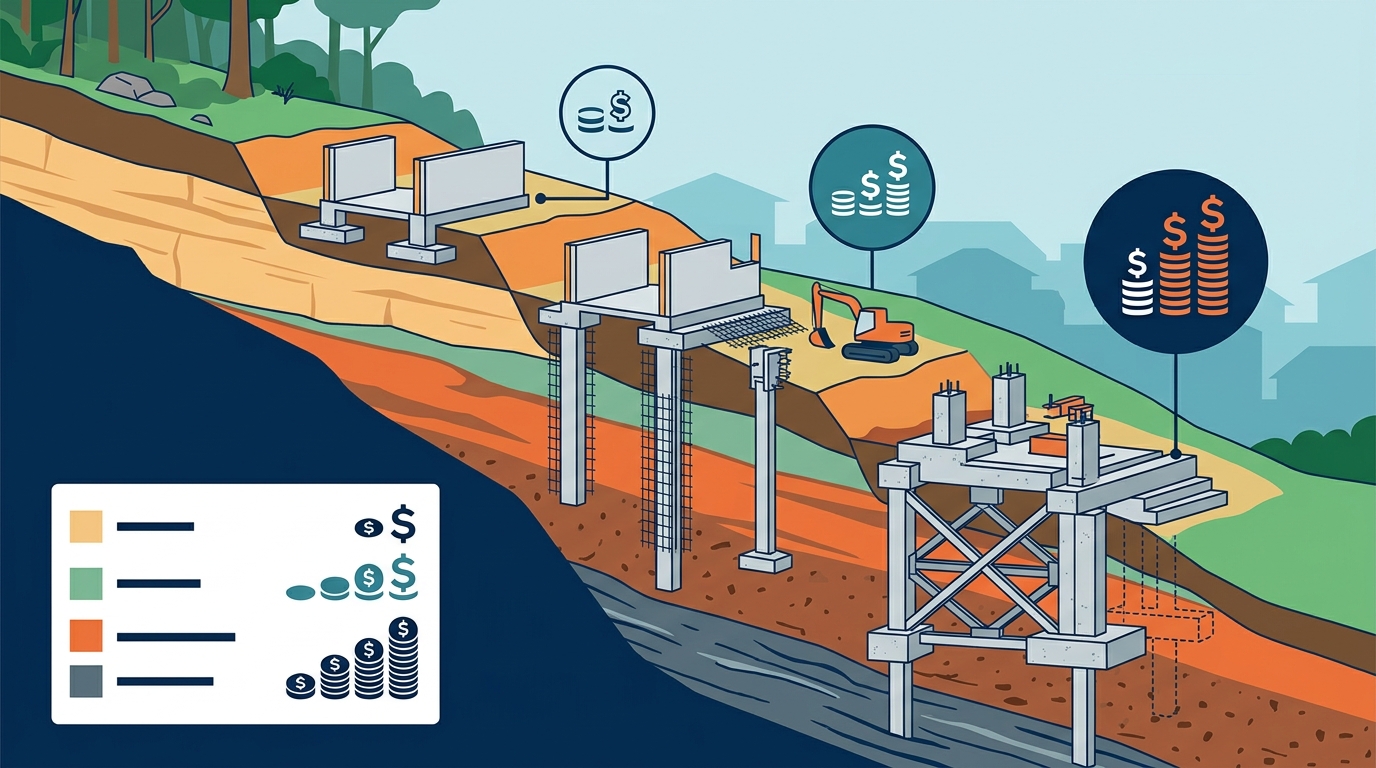
Steep properties in Sydney often require deep pile foundations or retaining walls to stabilize the build platform. These structural elements add substantial costs compared to standard slab-on-ground foundations used on flat land. The gradient of the site determines the volume of earthworks needed to create a level base for the home.
Soil type and moisture levels affect the level of ground disturbance required for appropriate operation on site soils, according to the United States Forest Service. On steep slopes, managing water runoff is equally critical to prevent erosion and foundation failure. Homeowners must budget for both structural engineering and landscape engineering to ensure long-term stability.
Financial Impact of Geotechnical Conditions
Geotechnical reports are the first step in understanding the true cost of building on a steep site. These reports identify soil classification, bearing capacity, and potential hazards like landslides or subsidence. The findings directly influence the choice of foundation type, which is often the most expensive variable in a sloped build.
Expansive clays, common in parts of Sydney, require specialized footings to accommodate soil movement. This can increase foundation costs by a significant margin compared to stable rock or sand. Accurate early assessment prevents costly mid-build changes when unexpected soil conditions are discovered during excavation.
Navigating Complex Builds with Expert Guidance
Allcastle Homes assists clients in understanding the specific geotechnical challenges of their steep Sydney properties. Our team works with experienced engineers to interpret soil reports and design appropriate foundation solutions. This collaborative approach ensures that structural requirements are integrated into the home design from the start.
We offer a range of home designs that can be adapted to suit various block sizes and gradients. For clients considering a rebuild on their existing steep block, our knock down rebuild service provides a pathway to modern living without relocating. Understanding the soil profile early allows for transparent pricing and realistic project timelines.
Key Takeaways
- Soil-structure interaction analysis is essential for evaluating the stability of foundations on steep sites.
- Unstable clay or sand requires specialized footings to prevent cracking and structural failure.
- Geotechnical reports should be commissioned before finalizing a building contract to avoid cost surprises.
- Steep gradients increase earthworks and retaining wall costs, which must be factored into the budget.
- Water management is a critical component of building on sloped terrain to prevent erosion.
- Early consultation with builders experienced in complex sites ensures structural and design alignment.
Frequently Asked Questions
What is a geotechnical report?
A geotechnical report is a detailed assessment of the soil and rock conditions on a property, providing data on bearing capacity, soil classification, and potential hazards.
How does soil type affect foundation costs?
Soil type affects foundation costs by determining the depth and type of footings required; unstable soils need deeper or specialized foundations that increase material and labor expenses.
Can you build a double storey home on a steep slope?
Yes, double storey homes can be built on steep slopes, but they often require engineered solutions like split-level designs or deep pile foundations to manage the gradient.
What is soil-structure interaction?
Soil-structure interaction is the analysis of how a building, its foundation, and the surrounding soil respond collectively to loads and environmental forces.
Why is water management important on steep sites?
Water management is critical on steep sites because poor drainage can lead to soil erosion, increased hydrostatic pressure on foundations, and potential landslides.
How early should I get a soil test done?
You should get a soil test done before selecting a home design or signing a building contract to ensure the design is compatible with the site's geotechnical conditions.
Start Your Steep Site Build with Confidence
Building on a steep Sydney property is a complex but rewarding endeavor that requires careful planning and expert guidance. By understanding the specific soil conditions of your site, you can make informed decisions that protect your investment and ensure a safe, stable home. Allcastle Homes is committed to helping you navigate these challenges with transparency and technical expertise.
Ready to explore what is possible on your steep block? to discuss your site and begin the journey toward your dream home.